

QA outsourcing vs test automation platforms

Dmitry Reznik
Chief Product Officer

Summarize with:
How do you feel, does the AI rush really slow down? We notice a remarkable signal — mid-sized businesses and enterprises look for narrower and more focused applications for this hyped technology.
One reason is that development velocity goes up, while testing falls behind.
In the 2025 AI Testing Research, Forrester stated that continuous automation testing platforms didn’t manage to automate more than 25% of tests on average in the industry.
McKinsey’s interview of Jellyfish CEO Andrew Lau on AI in software development found that this technology is not a silver bullet (not a surprise, is it?) — while helping with coding, AI doesn’t remove the need for compliance, governance, and software testing. And the way of testing is what actually moves the needle here.
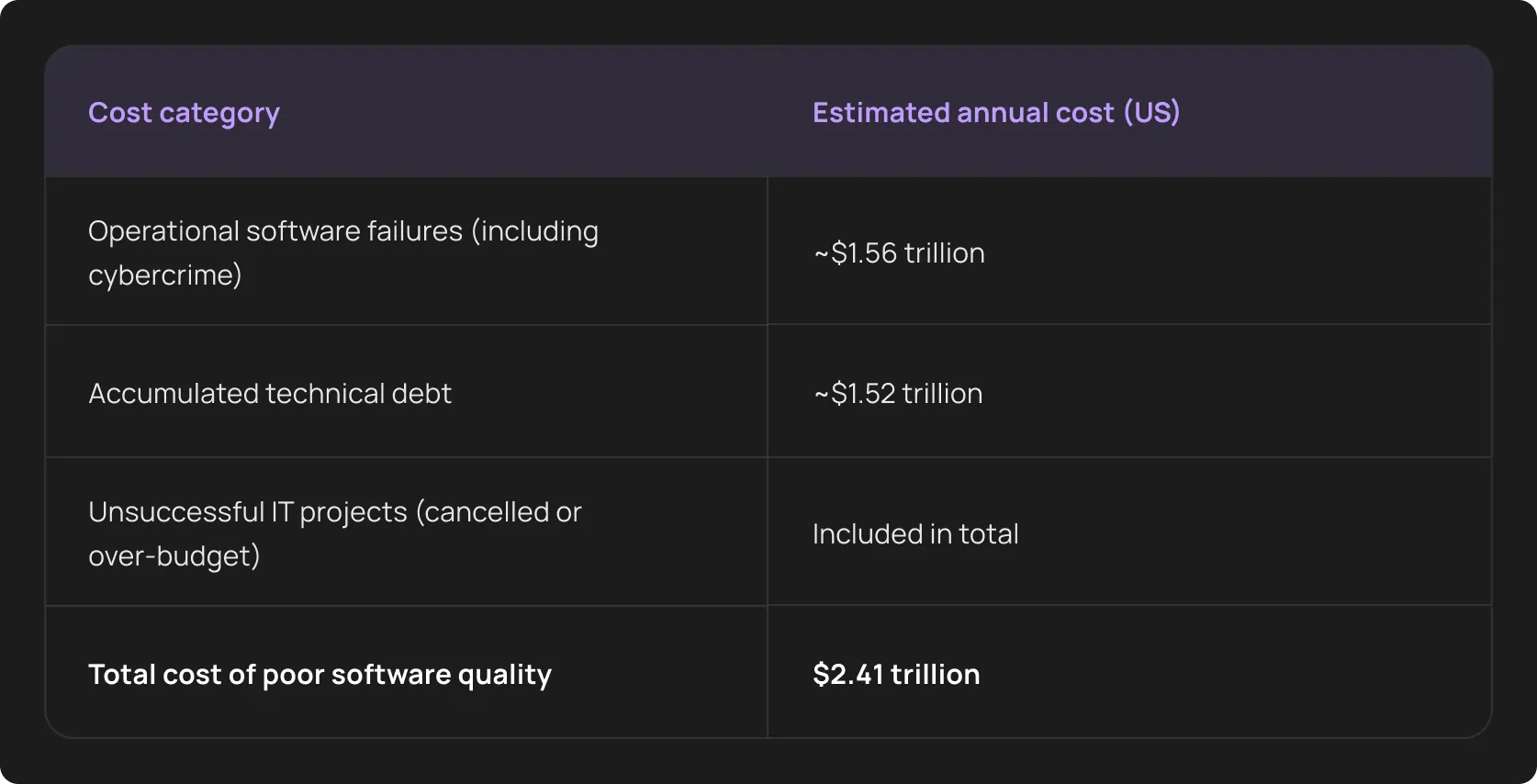
CISQ calculated the cost of poor software testing and quality failures in the US — it was about USD 2.41 trillion in 2022, about 330 billion more than two years before the study.
The thing is that most of that isn’t actually the result of careless teams. It’s the result of teams that can’t keep testing pace with the rate at which software is being built and changed.
That’s why many teams are actively investing their time and effort in artificial intelligence, hoping to finish what they began.
And here it is — two common solutions tech leaders come up with, trying to solve this problem:
- Outsourcing QA to external teams (turnkey service to save resources right now)
- Adopting test automation platforms (investing time to build a genuinely automated system to save resources in the long run).
Both have trade-offs, and choosing between them without understanding those give-and-takes produces either an ineffective vendor relationship or an incomplete initiative due to a flawed system.
Below, we compare two ways of reaching proper end-to-end testing: QA outsourcing and automation testing tools — what each approach delivers, where each one breaks down, and how to decide which fits you better.
What is QA outsourcing?
We all know the “standard” definition — it’s contracting external teams or testing vendors to handle some or all of a company’s testing scope. Sometimes, it’s feasible to outsource rather than build an in-house QA function.
Only a few mention the main caveat of the USD 50B-market approach — a constant search for a middle ground in typical situations: what the process will look like, what the definition of done is, and where the responsibility borders are.
What outsourced QA teams typically do
- Write test cases based on product specifications and business requirements
- Execute manual tests across browsers, devices, and platforms
- Document defects with reproduction steps, screenshots, and severity classifications
- Report bugs to the internal development team via Jira, Linear, or whatever issue tracker the team uses
- Retest fixed issues and confirm regression coverage before releases
The model varies by engagement: fixed-price model, time and material billing, SLA-based, etc. Some companies outsource a dedicated QA team that works alongside developers, others bring in external testers for specific release cycles or to augment the internal team during crunch time — a product redesign, a major feature launch, a platform migration, etc.
Why teams choose it
Speed to capacity: Hiring a dedicated QA Engineer takes a month or two. And even after job posting, screening, interviewing, and onboarding, there are no guarantees you’d hit it off with the hired specialist. An outsourcing vendor can gather a dedicated (or not) testing team in days or weeks. For quick-on-the-uptake firms, that speed matters.
Saving on permanent payment: The in-house team will get paid whether they have a full-fledged load or not. In the outsourcing case, the client pays for testing capacity as needed, scales it up or down, and doesn’t carry the overhead of full-time employees outside of peak season.
When it really works: two specific examples
- A SaaS company with a 5-engineer team is preparing a major release. Testing volume temporarily exceeds internal QA capacity. They don’t have enough time and money to rush a hire, so the team brings in an external QA vendor for 6 weeks to cover the release cycle — full regression testing suite, cross-browser validation, and API testing.
- An e-commerce platform needs cross-device and cross-browser coverage before a Black Friday campaign. The internal team handles product logic and integration testing. An external vendor handles the device matrix — 12 browser/OS combinations, iOS and Android, three screen sizes.
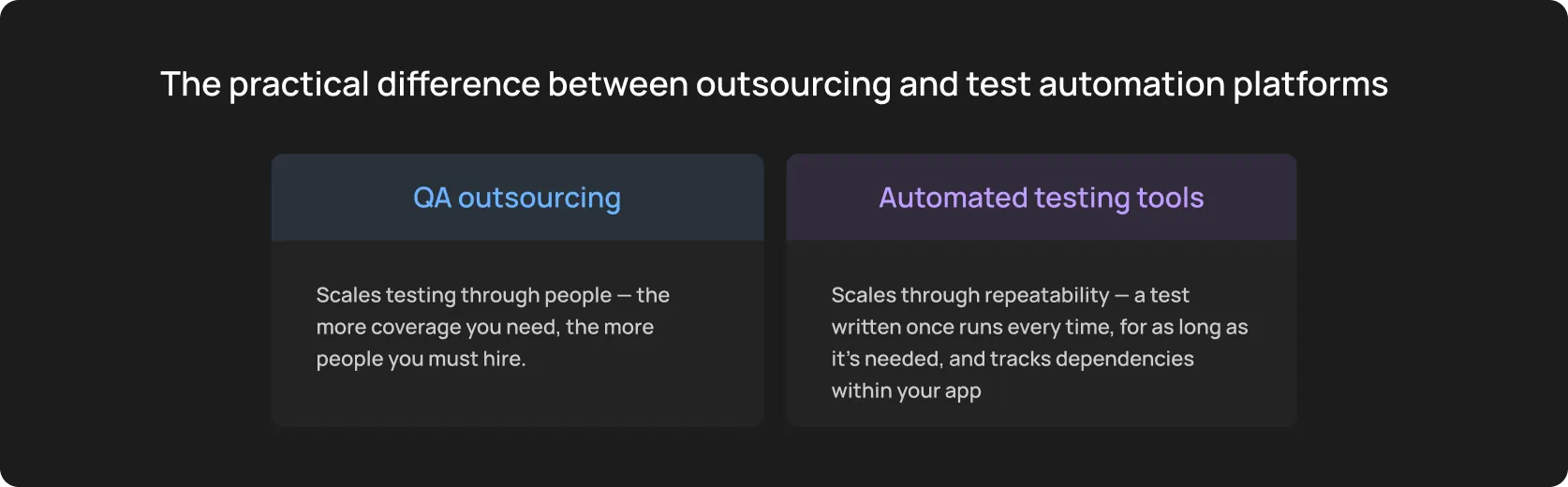
The limitation worth paying attention to: Outsourced QA is, in fact, a manual labor model. More testing capacity means more testers, more hours, more coordination.
What are test automation platforms?
These are software with a different approach — smart algorithms trained on the company’s data autonomously create, run, and maintain test suites. Usually, they have their own infrastructure for end-to-end testing.
The core function: Instead of everything routine and stressful (assembling a custom framework from open-source libraries, configuring CI pipelines, managing browser drivers, writing every test from scratch, etc.), such tools provide those components ready to use.
You just need to prepare the ground (datasets) and hit “the start button”, slightly refining your system as your product changes.
What test automation platforms help with
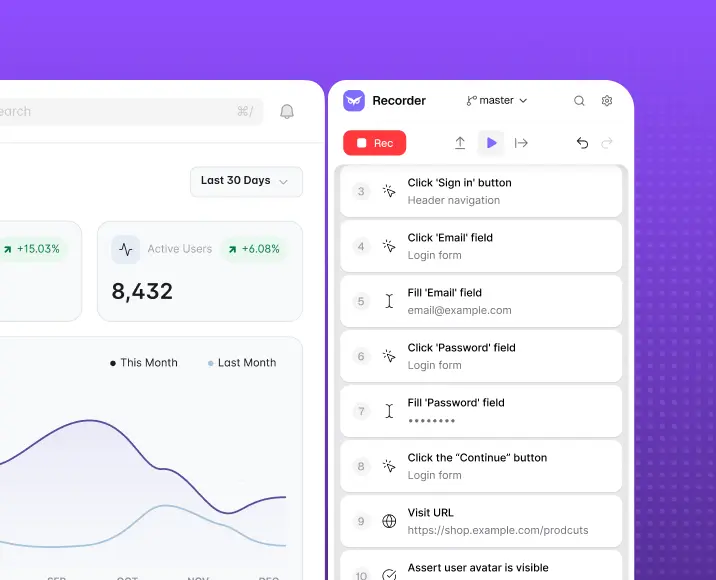
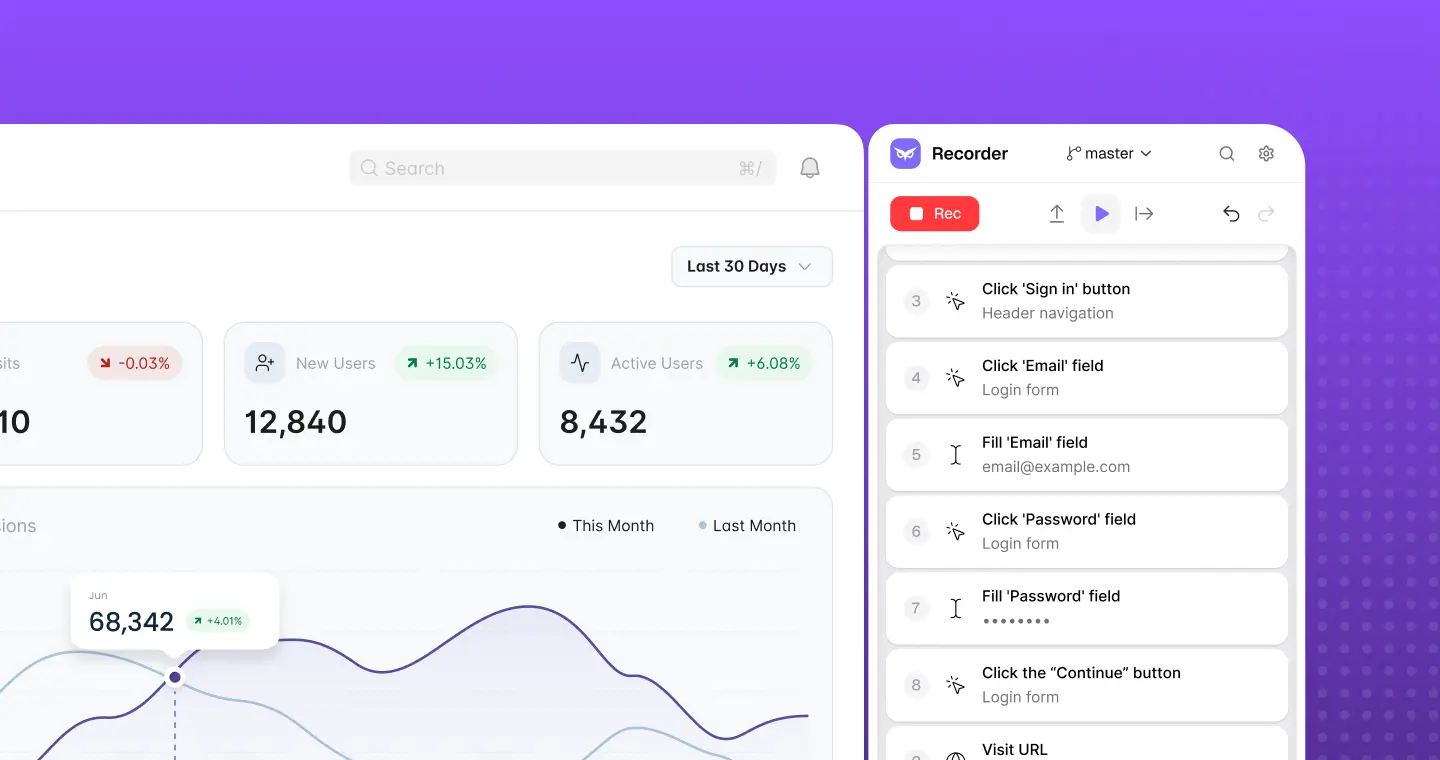
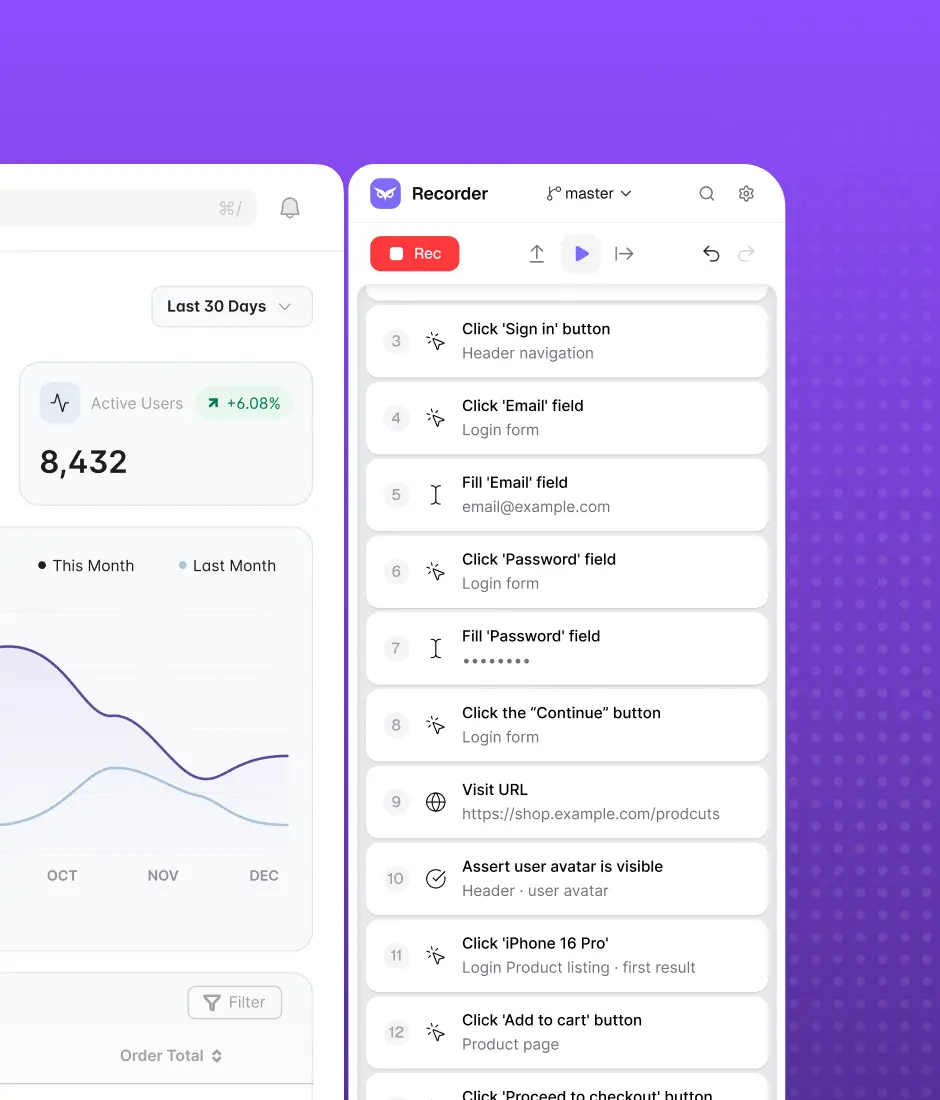
- Create tests from real user flows: Teams use their own product as their clients — they record how they move through the app (logging in, completing a purchase, submitting a form, and others), and AI converts that recording into an automated test.
- Expand coverage: It takes minutes to hours to capture initial flow, depending on the app’s size. Then, you can expand: more scenarios, more data variations, alternative user paths, edge cases. Teams can build this out themselves, leveraging non-tech team members’ experience and expertise to ensure they don’t overlook anything.
- Run tests simultaneously: You don’t need to trigger test suites — the tool prioritizes suites itself and runs the most critical/relevant. Moreover, it runs them across key user journeys simultaneously, without the team managing servers or runner configurations. You’ll get a report with logs, screenshots, and video. Some products even provide actionable insights.
- Adapt to product changes: When UI changes, traditional test scripts break. AI-powered testing tools with self-healing automation detect those changes and adapt the tests.
- Feed results back into existing workflows: You can use the report we mentioned above for additional supervised learning. Set up auto-feeding results into the project management or bug-tracking tool your team already uses. This way, you get a clearer workflow and a system that learns your app more and more with each release.
Almost a decade ago, Stripe predicted that developers would act as a force multiplier and would boost global GDP by USD 3 trillion by 2028. Now, we see that developers (and testers as well) shift their roles into operators for smart automated systems.
We are not in a fully autonomous tech world yet, but Microsoft found that most regions increase AI adoption (AI diffusion, to be more precise) by 1.2% every 6 months. And that’s across all social levels — a significant pointer.
Testing speed and feedback cycles
This aspect logically stems from the previous point — the key difference in the two approaches to software testing is in how quickly the team knows whether something is broken.
QA outsourcing: manual pace or constant check-ins
- Manual test execution: The first point — if your provider only tests manually, your scaling is limited to their speed. A middle+ QA Engineer can cover 50 to 80 test cases in the regression suite per day, depending on complexity. A SaaS startup that is looking for its Product Market Fit and testing hypotheses can’t afford this tempo.
- Structural problem in modern development: If a developer merges a change on Monday, and the outsourced QA team completes regression testing by Wednesday (remember the pace), the developer has already moved on to the next task. Context-switching back to debug a three-day-old issue is slower and more error-prone than fixing something that was flagged an hour after it was introduced.
- Communication adds friction: Imagine the external team discovers a bug, writes it up, submits it to the issue tracker, and someone internally needs to pick it up and route it to the right developer. If we are lucky enough, this takes a couple of hours. And what if the team is distributed or the software testing was offshored to the team from a faraway region?
Test automation platforms: double-checking or diligent data management
Autonomous work is a double-edged sword in some sense. On the one hand, after tuning, automated tests run on every code commit. On the other hand, if you fed the model inappropriate data, chances are the results would be “unacceptable” — the classical garbage-in, garbage-out.
However, if you selected relevant logs, bug descriptions, their business impact, and other important information, organized them well, you significantly increase your chances for success.
Fast feedback is the killer feature of modern QA services.
Developer merges a change → the CI pipeline triggers → tests execute simultaneously → results are back in minutes (or in hours if a really large part of the code was affected).
If something breaks, a developer sees it while the change is recent and concrete in memory.
A QA engineer verifying 50 API endpoints manually takes 2 to 4 hours. The same 50 endpoints covered by an automated suite take within minutes.
The feedback cycle improvement has downstream effects:
- Fast feedback for developers → they trust the results.
- Developers fix issues sooner → they’re less likely to ship regressions because the pipeline catches them before they reach staging.
Scalability
Sooner or later, the volume of necessary testing expands, and this growth tests your operation. Every new screen, API endpoint, and user workflow adds to the regression. How your testing model handles this growth determines whether QA remains a product’s strong aspect or becomes a release bottleneck.
QA outsourcing scales through people
- It relies on a linear scalability model: More tests in the same amount of time means more human testers. There are almost no other options.
- Scaling is limited to testers’ speed: Outsourcing testing providers can provide bodies quickly, but humans are limited by how fast they can manually click through an interface. Sooner or later, you’ll encounter a “glass ceiling” regarding the testing coverage.
- You want to prepare for outsourcing: Adding more external testers creates diminishing returns. Your engineers must dedicate some of their hours to writing documentation, explaining complex business logic, and onboarding external personnel who lack deep context about your product’s architecture.
- It requires skilful coordination: Your managers must constantly monitor vendor SLAs, review manual bug reports for duplicates or false positives, and bridge the communication gap between offshore testers and local developers.
Test automation platforms scale cost-effectively but require oversight
Automation scales differently — it relies on machine-speed execution (with a little human oversight), so test capacity is limited by cloud compute rather than headcount.
- What scales automatically: test execution. Owlity and other modern platforms run tests in the cloud simultaneously and across different environments. Whether the team runs 50 tests or 500 tests, the execution infrastructure doesn’t require additional reconfiguration.
- What still requires attention: coverage strategy. CTO, QA Director, or any other software testing leader still needs to correlate all testing initiatives with business goals: - which new flows should be automated
- what edge cases matter most
- whether existing tests still reflect current product behavior
Here, more coverage means more recorded flows converted to tests — not more people managing more test cycles. To keep up with product growth, you need a strategy to expand coverage, and this is actually where modern platforms require oversight.
Cost considerations
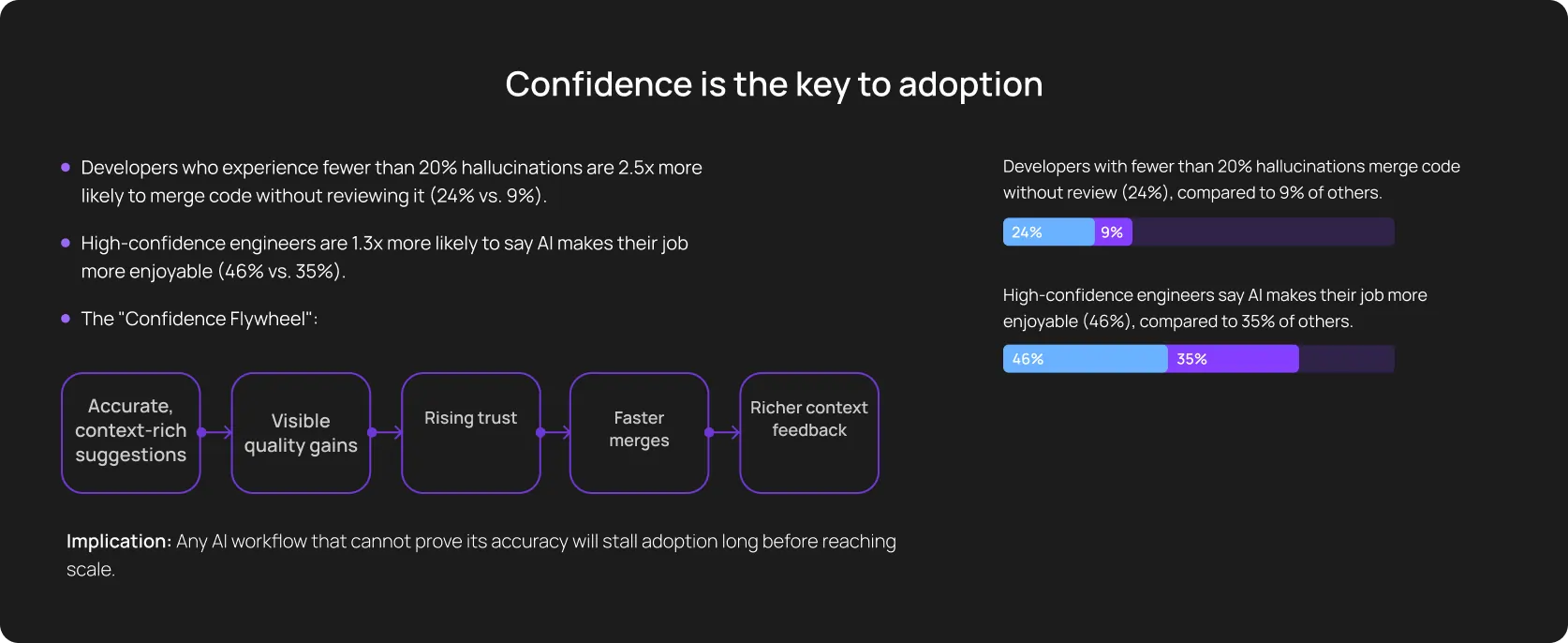
One approach ties directly to human labor, another to a cloud’s capabilities and general costs of improving and maintaining the AI model. Do not confuse the second option with just a predictable software subscription. Test automation platforms have one important caveat — AI in general forces developers to merge blindly.
QA outsourcing: The linear cost dependency
Outsourcing looks attractive on paper in the early stages, and many startups choose this approach to quickly test different product hypotheses and save some money (in case of success and suitable PMF). But in practice, it compounds into a massive financial anchor as the company matures.
- Hourly or monthly rates: There are several engagement models, as we’ve discussed, but mostly, clients pay for time. Agencies bill based on the hourly rates of individual testers or offer flat monthly retainer fees for dedicated teams.
- Cost growing with team size: Because manual testing scales linearly, your QA budget must increase every time your product complexity increases.
- Long-term operational cost: You are perpetually renting testing capacity. The moment you stop paying the vendor, your testing capability drops to zero.
Test automation platforms: Predictable scaling
You shouldn’t assume that AI tools require nothing to get started. In fact, they likely require even more — a shift in the tech leaders’ mindset and behavior — how the company allocates the testing budget.
- Subscription model: Most platforms operate on predictable SaaS pricing. You pay for parallel execution capacity, cloud storage, and platform access, which remains relatively stable regardless of how many times you run your tests.
- Lower operational load: The ongoing cost of running workflows drops near zero. Self-healing algorithms handle the UI maintenance, and your operational overhead stays low even as the product evolves.
Cost comparison: When outsourcing becomes unscalable
The cost difference between outsourcing and test automation platforms becomes painfully obvious when teams try to calculate their QA budget two years into a product roadmap.
Outsourcing rates vary widely depending on the region, the vendor’s expertise, and the complexity of your application. Yet, the main cost category is almost always human execution time.
Let’s be more down-to-earth and calculate.
Two caveats before we start:
- Offshore manual testing rates can appear remarkably low (sometimes as low as USD 15 - 20 per hour), but these rates often hide the massive internal management overhead required to coordinate across time zones and language barriers. For a realistic, managed nearshore or high-quality offshore agency, a blended rate is generally higher.
- Manual execution speed depends heavily on the application state. Testing a complex B2B financial dashboard takes significantly longer per test case than clicking through a simple consumer e-commerce site.
Conditional example and calculation
Given: Growing SaaS with bi-weekly releases. They have a core regression suite of 800 complex test cases that must be verified before every deployment (2 full runs per month).
To keep up with development, the company hires a dedicated QA outsourcing team of 4 full-time manual testers. Let’s assume a highly competitive blended vendor rate of USD 35/hour.
The math:
- 4 testers x USD 35/hour x 160 hours/month = USD 22,400/month in pure manual execution costs.
- Total recurring operational cost = USD 268,800 in a year.
If the product team doubles features over the next 18 months, they need to hire 4 more testers to just keep the same two-week release velocity. The cost will hit USD 44,800/month.
This is the structural problem with QA outsourcing: the more features you build, the more you are penalized financially.
→ Conversely, with an automation platform, the core cost is the software subscription. You might need one internal QA Lead to oversee the testing strategy and use the platform’s AI.
Testing coverage and consistency
If you remember, we began this blog with a definition of QA outsourcing. A classic way to wrap up the article is to define something related and bring it full circle.
So — testing coverage is often misinterpreted as the number of tests you have. In practice, coverage is how reliable your tests and the execution approach are.
QA outsourcing
A tester can work through a defined set of scenarios in a given session, but they can’t execute everything the same way every time. When a product has hundreds of test cases across multiple flows, devices, and browsers, triage is inevitable.
Now, add scale:
- Attention reduction and fatigue: A tester running a 200-case regression manually on the third sprint day may miss a subtle state issue that they would have caught on the first day. And not because they are inexperienced — it’s physiology.
- Inconsistent execution: Different testers follow test cases differently. And this brings us back to the matter of different grades/skill levels of specialists in the provider’s team.
- Coverage decisions under time pressure: When releases are tight, and the outsourced team has to prioritize, those decisions are made without full visibility into which flows have changed most recently or carry the highest risk.
Test automation platforms
An automated testing tool doesn’t change the test. It may suggest replacing or removing a specific test, but won’t do it without permission. And the execution is the same, every single time: same steps, the same assertions, the same sequence.
And while it may be the strongest benefit and a significant flaw at the same time, removing the human error factor is the core value proposition of such instruments.
A case to note: IBM ensures consistency in SAP testing
SAP customers generate 84% of global commerce. And just imagine how critical impeccable testing is here. IBM analyzed complex system testing and noticed that manual execution of high-volume workflows is too variable.
When testing large-scale architectures, manual testers frequently overlook edge cases simply due to the sheer volume of data combinations required.
IBM implemented GenAI automated testing tools and ensured accurate execution every time. Moreover, they boast 90% execution time reduction in one case.
Comparison summary: QA outsourcing vs test automation platforms
Both approaches solve a real problem, but they solve it differently: unlike cost structures and unlike scaling.
Combining QA expertise with automation
The core message — do not get stuck in just one bucket. You want to ensure a smooth and reliable software testing process, don’t you?
So why limit yourself if you just need this job to be done?
Look for QA outsourcing when you need skilled specialists for short-term tasks or have concrete challenges, such as launch cycles, fixing UX, or usability validation.
If you focus on ongoing regression coverage, CI/CD integration, frequent shipping and don’t want to bloat a headcount, seek proper automation QA services.
Monthly testing & QA content in your inbox
Get the latest product updates, news, and customer stories delivered directly to your inbox