

The real cost of slow test automation (and how parallel execution solves it)

Dmitry Reznik
Chief Product Officer

Nov 13, 2026
Summarize with:
When past tech leaders came up with the first automation frameworks, they aimed to improve test execution speed. And they solved the problem for many teams… temporarily. Typically, until the product grows large enough that the test suite becomes exactly the thing slowing everything down.
A team builds an automated regression suite of 300-400 tests, the suite covers the core workflows, and is wired into CI. It runs 12 minutes. The entire system earns trust because it’s effective and efficient.
Then — more features, more integrations, more edge cases, more coverage in general. The previous 12-minute run becomes 40 minutes, maybe even 80. Developers stop waiting for CI results before merging. The pipeline that was supposed to be a quality gate becomes a formality.
The 2026 State of Software Delivery report states that main branch success rates have dropped to 70.8% (the industry benchmark is ~90%). Recovery from a failed merge takes an average of 72 minutes, up 13% year over year.
The signal flipped upside down — no longer is the bottleneck of how fast teams can write code, it’s how fast they can safely get it through to production.
The cost of that shows up in developer productivity: context-switching, release frequency, devaluation of automated testing at all.
The cost of generating code is heading toward zero, but every line of code still needs to be tested and verified. None of that got faster because code generation did.
Below, we break down where slow test automation actually comes from, what it costs in operational terms, and how parallel execution addresses the problem.
Slow test automation delays development feedback
The speed at which a team can act on a test result is directly proportional to how useful that result actually is. A failure you spotted in three minutes costs the same minutes to fix. The failure 90 minutes later costs significantly more (some studies put the figure at x100).
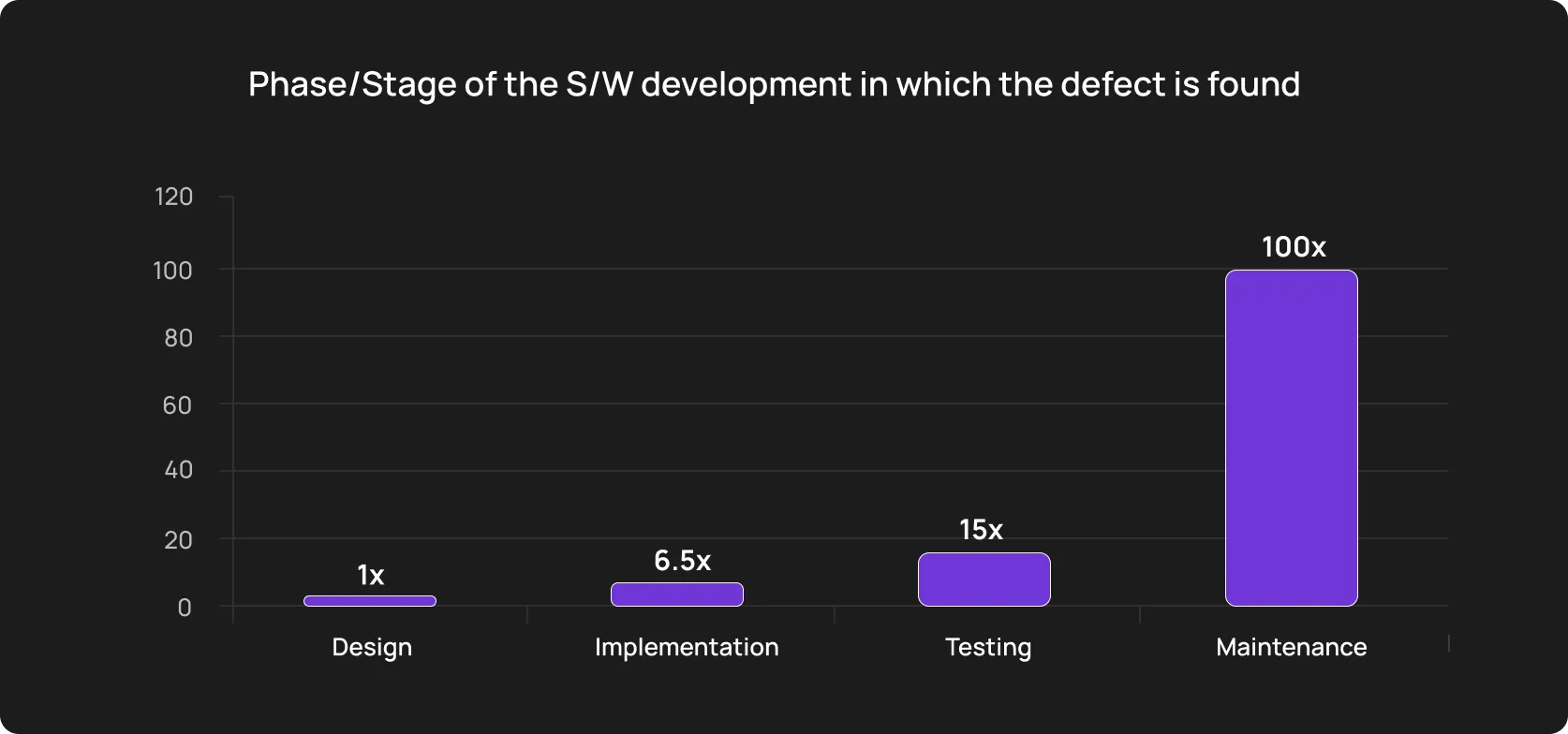
NIST’s research on software testing infrastructure confirmed this directional finding in far 2002
Research on developer cognition states that context-switch recovery takes 15 to 25 minutes after every interruption. That is, a slow pipeline not only delays the fix but also multiplies the cognitive (and, hence, productive) cost of every bug.
We see some good examples of proper acceleration in the industry. Scoops, a 2024 DORA Award winner, went from 44% to 0% change failure rate and increased feature delivery speed by 700%.
They applied DORA principles related to our topic: tighter feedback loops and continuous parallel test execution. This allowed them to ship features weekly instead of quarterly.
There is also another interesting fact for us in this case. Teams that weren’t seeing downstream quality improvements from AI tooling had one common thing — their feedback loop hadn’t kept pace with code generation speed.
What this has to do with our topic — the dev team usually delivers features way faster than the QA team can check their feasibility and functionality.
There are three common cases where slow test suites create friction:
- Stalled continuous integration pipelinesLimited concurrency appears on available runner threads and causes subsequent pull requests to queue and blocks unrelated feature merges.
- Successive approach creates merge windows, and devs are losing themA developer opens a PR at 11 am, CI starts, the suite finishes at 12:30 pm while the developer is in a planning meeting. The results come back with a failure, the developer picks it up at 2 pm. Meanwhile, three other PRs have merged into main. The fix requires a rebase. Instead of a 15-minute loop, we have a two-hour process. Imagine the volume across a team of 12 engineers running 8 PRs per day.
- Feedback is too late and often isn’t actionableA team introduced a regression testing suite in the afternoon, and the next day, the developer has to reconstruct the context of the code they wrote 12 to 18 hours ago. In an enterprise scenario, specific services are owned by different teams, this adds another half-day for routing a potential issue.
Longer regression cycles slow down releases
Regression is a routine, but an important routine.
With multiple authentication states, third-party APIs, complex user journeys, there will be thousands of assertions from a QA perspective. When testing infrastructure can’t keep up, this eliminates development effort.
In an enterprise environment, sequential execution of a mature regression suite frequently exceeds 12 hours. This latency forces engineering teams to run automated checks overnight.
This creates business friction:
- Pre-release queueing: Feature branches pile up in the staging environment waiting for the nightly regression to clear the code for production.
- Delayed feature validation: Let’s face it, many teams validate a specific number of features (specific parts of code), not all of them. Even if they do it, a single timeout or environmental failure during an overnight run invalidates the entire suite.
The financial impact of this bottleneck is often hidden.
Let’s take a 2,500-test regression suite, sequential execution. This usually requires 14 hours to complete.
Imagine this:
- 2 routine environmental failures per run requiring triage and a subsequent 14-hour re-run
- 6 engineers blocked from merging new code for 24 hours at USD 80 - USD 120/hour
- 144 total engineering hours lost to pipeline waiting
A single stalled regression cycle costs the company at least USD 11,520 in engineering time.
Developer productivity decreases
Engineering productivity isn’t the only and even isn’t the most influential indicator of revenue growth. But it is among the direct influential factors.
There was interesting research in the previous decade. McKinsey found that companies in the top quartile of the Developer Velocity Index outperformed bottom-quartile peers by up to 5 times in revenue growth (2014-18 years).
Example
Given: A B2B SaaS platform, and we want to check a core payment flow (without proper CI/CD testing).
Situation: A developer commits a single-line patch to resolve a database connection timeout. If the functional validation suite requires 2 hours to run, the fix remains unverified, it blocks the deployment, and user transactions continue to fail. We are losing money.
Three typical reasons for losing productivity
- Blocked pull requests: Code reviews stall because downstream branch verification queues are behind long-running test suites. This prevents clean integration and forces branches to diverge from the main line, which, in turn, increases the chance of complex merge conflicts.
- Delayed fix checks: When a test fails due to a minor syntax error or an environmental issue, the developer must apply a correction and restart the entire long-running pipeline. This cycle repeats, sometimes turning a five-minute fix into a multi-day process.
- Task-switching: Idle time forces engineers to switch to unrelated feature branches to maintain utilization targets. Cognitive re-loading inevitably increases defects in the new work.
CI/CD pipelines become inefficient
Repeatable execution loops are the primary purpose and core features of continuous integration. The objective is rapid validation and maintaining a stable main branch. So, when test execution speed is slow, it undermines the architectural foundation of continuous deployment.
Three unobvious consequences of inappropriate CI/CD testing
- It changes team behavior: Running time exceeds acceptable limits → teams stop merging code frequently. Developers might start accumulating large code changes over several days to avoid triggering the slow pipeline multiple times. This not only takes additional time, but also brings many risks.
- It weakens business agility: High-severity security patches and critical feature updates can get trapped behind long validation queues. If you can’t deploy on demand, you’ll shift back toward rigid scheduled release windows.
- It increases cloud expenditure: Sequential execution keeps cloud infrastructure nodes active for extended periods. It’s extremely inefficient resource management.
Instead of a parallel testing gate, teams often rob themselves by creating a rigid infrastructure process they actually want to bypass.
Test suites become difficult to maintain
Suites’ volume isn’t the only reason for delays. When we analyze pipelines taking hours to complete, we usually uncover deep architectural debt. Slow suites mean structural flaws that demand engineering intervention in most cases.
We see maintenance effort compound across three specific failure modes:
- Duplicated user journeys: Teams often copy entire authentication or setup flows instead of building isolated checks from the outset — QA shouldn’t check 50 times the separate (yet standard) user registration flow.
- Inefficient test design: Every time the tech team drives the browser to verify something that could be checked with a direct backend API call, they are choosing the slowest, most brittle path possible. Run that check through the UI, navigate through multiple screens, load front-end components, wait for asynchronous calls, and then finally assert what’s essentially a data ordering rule.
- Hardcoded waits: Scripts that wait on fixed sleep commands or rely on slow database seeding inflate the total run.
This way, every minor layout update breaks dozens of scripts. Engineers stop writing new checks and “take a second full-time” to manage the existing automation repository.
Parallel execution dramatically reduces test runtime
Let’s take a standard suite that already takes 45 minutes to run. Every sprint, a team adds 40 tests, which adds roughly 4 to 5 minutes to a pipeline. With the sequential approach, within two quarters, the same suite that once ran in under an hour runs in two.
Parallel test execution parts the suite across multiple workers to run simultaneously. The total execution time is the execution time of whichever worker gets the heaviest partition. Roughly the total test runtime divided by the number of workers, adjusted for uneven distribution.
How this works
A team has 600 end-to-end tests. Average test runtime: 90 seconds. Let’s do the math:
Sequential execution on a single runner: 1.5 min x 600 / 60 = 15 hours. (Note: that doesn’t run on every PR).
Distribute those 600 tests across 30 parallel workers:
600 tests x 1.5 / 30 workers = 30 minutes
Across 60 workers: 15 minutes.
Across 100 workers: under 10 minutes (a release-gating window for a team shipping several times a day).
The coverage is identical, what’s changed is how many workers the suite runs on. The 15-hour sequential suite becomes a 10-minute end-to-end testing suite.
⚠️Important. Isolate tests. Ensure they do not share database records, user accounts, or mutable global state. Otherwise, it will produce race conditions under parallel execution. Tests must be independently executable: each sets up its own preconditions, runs, asserts, and tears down.
This is why parallel test execution is the most direct structural fix for slow automation pipelines. Test prioritization, flaky test remediation, infrastructure optimization, and other measures improve the situation at the margins.
Modern testing strategies rely on parallel execution
Check whether the teams that don’t use this testing practice are noticeably struggling compared to the ones that do. By that measure, parallel execution has moved well past emerging practice into baseline operational infrastructure for automated testing advocates.
Even though many tech teams have already transitioned to automation as a main approach in testing, 75% of those surveyed by Capgemini state that combining this approach with CI/CD is among the top challenges.
At the same time, those teams are already seeing 72% of improvement in software testing speed. However, speed itself isn’t the goal. So, let’s find other strong benefits in different layers.
Automation influence in different testing layers
- Large-scale testing: A mature product with two or three years of development history carries a test suite that reflects that history: hundreds of E2E tests, integration tests across multiple services, API tests validating every significant endpoint. Without parallelization, the suite will be run only before major releases (read occasionally rather than continuously).
- Sped-up regression: The most direct business case for parallel execution. The benefit is obvious — instead of 90 minutes to run, the same suite runs under 12 minutes on distributed workers. Speaking from experience, this is the shift where teams stop treating CI results as optional information.
- CI/CD integration: A CI pipeline built around parallel testing behaves differently from one built around sequential runs. Developers get results in the same window as a code review cycle. Failed tests are fixed before the PR lands in the main branch. This way, a pipeline becomes a filter, and not a notification system.
How modern automation platforms help teams run tests faster
Setting this up from scratch means parallel runners, managing container lifecycles across workers, configuring browser driver versions in each worker image, handling test data isolation (at scale!), and maintaining the infrastructure as the test suite grows.
And now, let’s imagine two teams:
- Those with a dedicated DevOps function — listed is usual work.
- Those without are also responsible for infrastructure maintenance, but it absorbs too much capacity, stealing it from going to coverage.
Also, custom infrastructure needs specific QA Engineers to manage the environment. Scaling CI/CD testing infrastructure means an on-demand cloud.
So teams often end up building complex orchestration scripts to scale up for a regression run and tear down afterward to control cloud expenditure.
Tech-savvy engineering teams bypass this infrastructure overhead by adopting AI test automation platforms. This removes the requirement to manually configure concurrency.
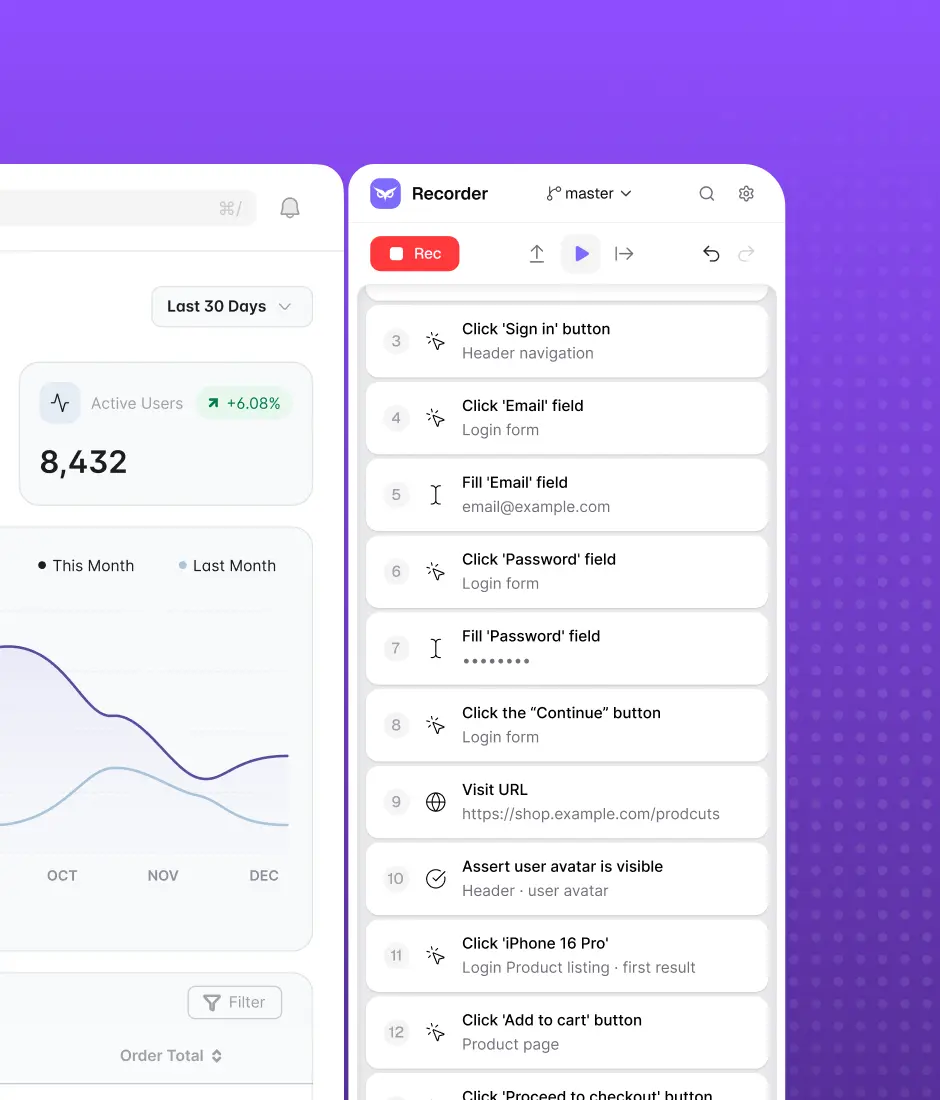
A team member records a real user flow via the in-built recorder (we call it Owlity Recorder in our product). From there, QA experts + AI expand automation, and years of vendors’ QA expertise ensure deep coverage.
Pay attention to the execution layer: your team should isolate data, remove unnecessary dependencies, organize suites well, and execute in the cloud (Owlity has one).
Yet, the critical shift is always the decision of company leaders — whether they are ready to improve their strategy even if it feels uncomfortable at the very beginning.
Monthly testing & QA content in your inbox
Get the latest product updates, news, and customer stories delivered directly to your inbox